Exhibition
SIDEREAL
Gravity without borders, celestial fields
September 20 to October 18, 2026
As part of the exhibition "An Assembly for the Cosmos"
Artists: Marcela Armas + Gilberto Esparza
curator : Remigio Valdés de Hoyos
Opening: Saturday, September 19, at 4 p.m., during the Autumn Launch
Adélard presents, in collaboration with Espacio México Montéal, SIDERAL – gravity without borders, celestial fields , an installation by Mexican artists Gilberto Esparza and Marcela Armas, at the Bishop Stewart Memorial Church of Frelighsburg Developed following a creative residency by Gilberto Esparza at Adélard During the summer of 2026, the work consists of an installation that connects an exceptional meteorite that fell to Earth more than 4000 years ago, on loan from the Montreal Planetarium, to the church's heritage organ, allowing this extraterrestrial material to resonate throughout the building.
At the crossroads of art, science, technology, and the cosmos, SIDERAL – Gravity Without Borders, Celestial Fields invites us to rethink our relationship to matter, gravity, and forces that transcend the human scale. The work blurs the boundaries that define our world, while simultaneously prompting reflection on the emerging issues of ownership and colonization of space.
This installation is presented as part of the multi-site exhibition * An Assembly for the Cosmos *, a large-scale collaborative project taking place jointly at the Galerie de l'UQAM and MICA | Institut d'art contemporain de Montréal . It is also part of a long-standing partnership between Adélard and ESPACIO MEXICO Montreal.
-
It's something the cosmos has never learned to do: recognize a border. Meteorites traverse the atmosphere, indifferent to maps, nations, and walls; they fall wherever gravity calls them. Around 4,000 to 5,000 years ago, a meteor shower struck the territory now known as the Argentine Chaco, leaving some 20 craters spread over several kilometers. Historical accounts associate this place with the name Piguem Nonralta , which the Spanish later translated as Campo del Cielo ("Field of Heaven")—a name that would subsequently designate the entire meteorite field and the fragments found there. One of these fragments, composed of 48.2 kg of iron and nickel, will one day pass through the doors of an Anglican church in the heart of the Eastern Townships, founded in 1809 and rebuilt in its current form at the end of the 19th century.
And yet, this is precisely what is happening with Gravity Without Borders – Celestial Fields , an exhibition that includes SIDERAL: Piguem Nonralta (Field of the Sky) , by Mexican artists Marcela Armas and Gilberto Esparza. SIDERAL is a series of projects dedicated to the imaginaries of the cosmos, including the project presented at Frelighsburg constitutes one of the chapters.
SIDERAL: Piguem Nonralta
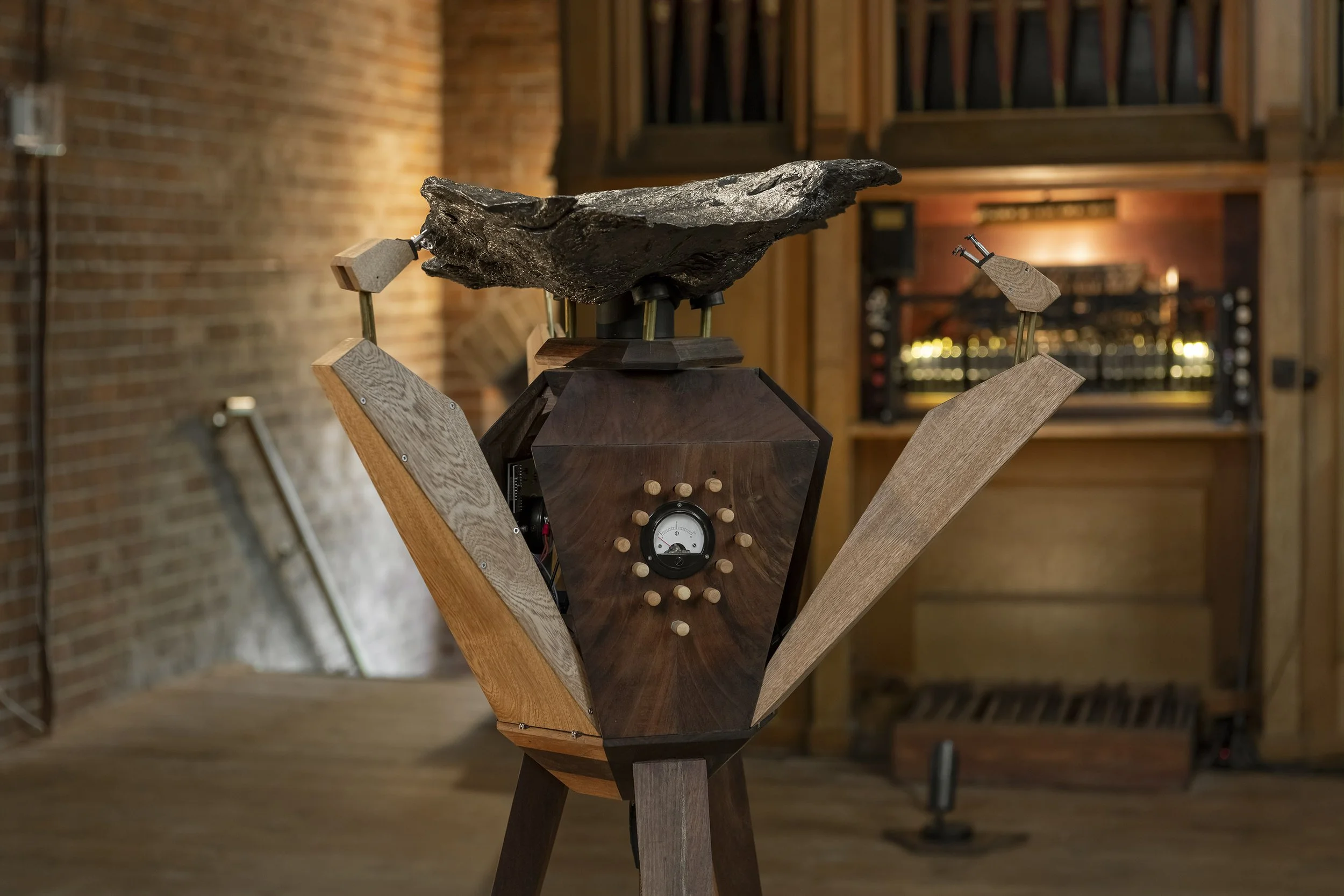
At the heart of the project is an instrument designed by the artists to capture the magnetic field of a meteorite and transform it into a sonic gesture. It represents a direct, mechanical coupling between two materials: the meteorite and the instrument it sets in motion. The meteorite's fluctuating, invisible magnetic field is captured by sensors that transmit analog signals. Variations in these signals are converted into parameters that mechanically activate the keys of an organ. This fragment of Campo del Cielo thus provides the physical impulse that allows its presence to be heard through the instrument.
For Frelighsburg, this device was designed in direct dialogue with the historic organ of Bishop Stewart Memorial of the Holy Trinity Church, currently undergoing restoration. The Campo del Cielo meteorite—on loan from the Montreal Planetarium—is presented to the public in the immediate vicinity of the electromechanical instrument, which inhabits the nave like an organic and contemporary extension of space, with the organ as its principal voice. During opening hours, this instrumental alliance with the meteorite creates, without an organist, a display of notes and chords, performed in harmony with the variations inherent in the celestial body's magnetic field.
The organ carries within it the acoustic memory of the place: the services, the silences, the voices, the winters. The meteorite, on the other hand, carries a memory of a different nature: mineral, extraplanetary, almost immeasurable. Magnetism here becomes a language: a form of animation of matter, a pulse from before human history that now finds ways to resonate in the present. A third, discreet soundtrack weaves into this ensemble the memory of the fragment's territory of origin and the indigenous peoples who first welcomed it to Earth. Three memories then meet: that of the organ, shaped by centuries of worship; that of the meteorite, mineral and cosmic; and that of the territory and its first inhabitants, ancestral and embodied. From their encounter is born a new, unpredictable time: the time of listening.
Gravity Without Borders – Celestial Fields is part of a broader reflection, characteristic of the SIDERAL series, on the cultural imaginaries linked to meteorites. In certain communities located near impact craters, these objects contribute to the construction of collective identity. The project extends this intuition: what if magnetism were a form of memory shared between humans and the non-human entities that inhabit our world? What if the dichotomy between nature and culture, body and mind, terrestrial and cosmic, were less rigid than we think?
The installation offers a space for contemplation where sound becomes a medium, not to illustrate science, but to make perceptible what it has not yet been able to name: that we are made of the same matter as the stars and that this matter has never ceased to be in motion, in relation, in transit.
When the cosmos crosses the threshold of the church, it does not ask permission.
-
Presented this fall, An Assembly for the Cosmos takes over three places: the UQAM Gallery , MICA | Montreal Institute of Contemporary Art ( curator : Antoine Bertron) and Adélard , in the Bishop Stewart Memorial Church in Frelighsburg ( curator : Remigio Valdés de Hoyos). The project invites us to take a fresh look at the cosmos, which has always captivated our imaginations and shaped our relationship with the world. While the current context is marked by ambitions for space exploration, the assembled artists highlight a plurality of knowledge and sensibilities through works that mobilize materialities imbued with emotion—meteorite, stone, sealskin—and diverse media, such as sculpture, beadwork, installation, video, and sound. Bringing these works together thus becomes a way to create a dialogue between these perspectives, to intersect fields of knowledge, and to open a space for reflection, debate, and collective speculation on our relationship with the Universe.
With the powerful influence of the private sector and the return of grand national ambitions, the prospect of space colonization, as promoted by the speeches of the sector's magnates, seems increasingly prevalent and inevitable.It then becomes imperative to understand the origins of these structuring imaginaries and to grasp the vast extent of other relationships to the cosmos that they obscure. Faced with these dominant narratives, the enrichment of worldviews and the amplification of anti-colonial and non-extractive perspectives, for the building of shared, sensitive, and plural futures, are becoming increasingly urgent.
An assembly for the cosmos poses the following questions: how can we highlight imaginaries, socio-cultural singularities, and ancestral, indigenous, community, and more-than-human knowledge in our relationship to the cosmos? By placing these planetary ontologies and sensibilities at the center through contemporary art, is it possible to constitute an assembly for the cosmos founded on intra- and interplanetary solidarities?
-
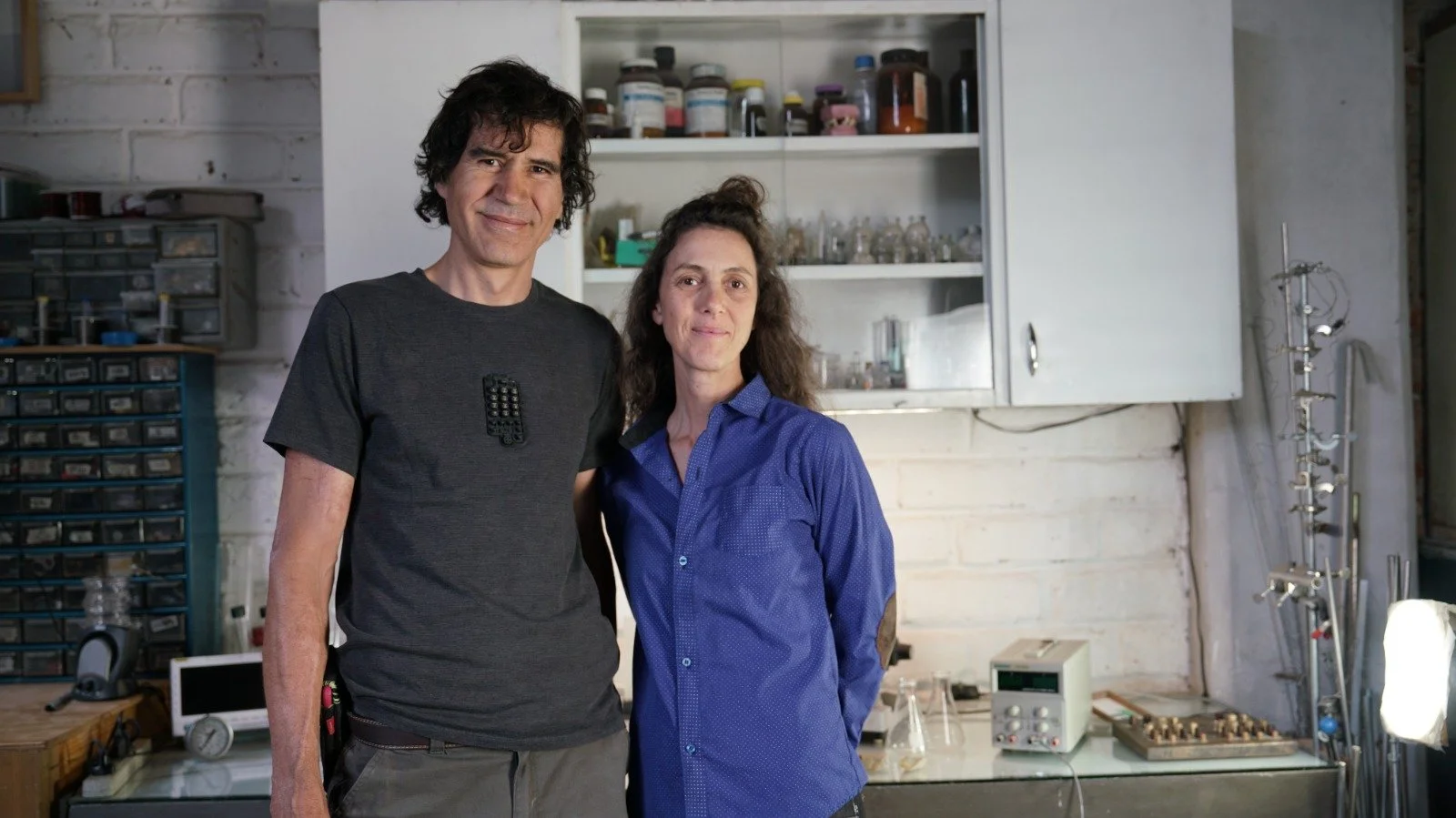
Marcela Armas is a Mexican transdisciplinary artist and researcher whose practice combines art, science, technology, and ecology. She explores the relationships between body and territory, knowledge, archive, and memory, as well as the processes of autonomy and resistance in situated contexts. Through machines, sound devices or instruments, installations, documentary objects, and electronic and analog media, her work is oriented towards transdisciplinary research methodologies, making environmental ethics a basis for imagining possible futures focused on the reconquest of autonomy, care networks, and sustainable lifestyles. She offers a critical reflection on the extractivist and market logics of the capitalist model, articulating substances, materials, artifacts, geological and human archives, community knowledge, testimonies, and complex and diverse living ecosystems.
Gilberto Esparza lives and works in San Miguel de Allende, Mexico. His practice lies at the intersection of art, science, and technology, through interventions in damaged ecosystems and critical socio-environmental contexts. He proposes new forms of existence arising from the assemblage of artificial-technological systems and organic life forms, aiming to redirect the potential of technology toward bioremediation and a more equitable and horizontal interspecies coexistence. Gilberto Esparza has presented solo and group exhibitions in Mexico, Latin America, North America, Europe, Asia, and the Middle East. In 2017, he presented the solo exhibition Plantas autofotosintéticas at the Galerie de l'UQAM. He received the Golden Nica in hybrid art from the Ars Electronica Prize, the second prize of VIDA 13 from the Fundación Telefónica, an honorary distinction from Ars Electronica, as well as the Ibero-American production prize VIDA 09.
Remigio Valdés de Hoyos was born in Monterrey, Mexico, in 1958. A self-taught artist since the age of thirteen, he nevertheless studied architecture at the National Autonomous University of Mexico before devoting himself entirely to the visual arts from 1975 onward. He trained in copperplate engraving in Paris (Lacourière-Frélaut workshop, 1978) and then in lithography in Mexico City with Andrew Vlady (1984). In 1997, he incorporated the Talavera ceramic technique into his work, which was exhibited at the Palace of Fine Arts Museum in Mexico City, and later in Washington, D.C., and Berlin. He settled in Montreal in 1999. His works have been exhibited in Mexico, Germany, the United States, France, Spain, Cuba, and several Asian countries. In 2001, the Montreal Museum of Fine Arts acquired his triptych Cielo for its permanent collection. In 2005, he made his debut as an experimental filmmaker in Japan with the film "Wild Angels".
Partners
The SIDERAL exhibition – Gravity without borders, celestial fields – is produced by Adélard in partnership with ESPACIO MEXICO Montreal, the Municipality of Frelighsburg and MICA.